
Johnson’s goal seals historic European triumph for Spurs
By DK01__
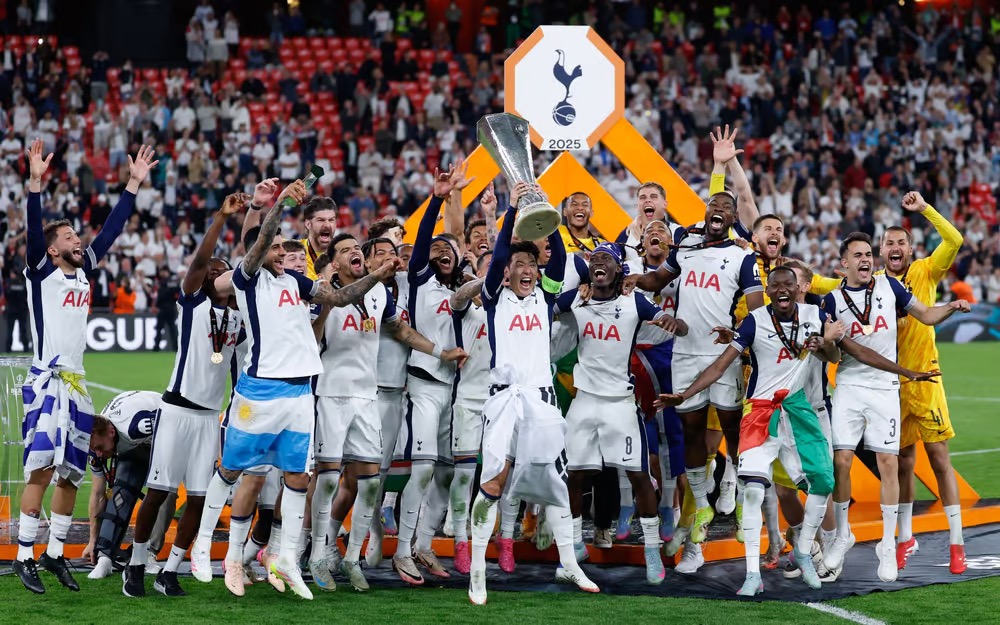
Tottenham Hotspur have ended a 17-year wait for silverware with a 1-0 victory over Manchester United in the Europa League final at San Mames. In the process, they secured Champions League football for next season and handed manager Ange Postecoglou the first European trophy of his career — in the second season, just as he predicted. This wasn’t the flowing, expansive brand of football the Australian coach has become known for. In fact, it was anything but. Tottenham had just 27.7% possession, three shots, and completed only 112 passes — the lowest recorded in a major European final since 2009-10. And yet, they got the job done.
Not the Usual Spurs
What stood out most in Tottenham’s Europa League triumph wasn’t just the result — it was the departure from the identity many had come to associate with Ange Postecoglou’s teams. This wasn’t the high line, relentless press, and free-flowing possession game that defined his early months in north London or his success at Celtic. Instead, Postecoglou delivered something very different: a carefully measured, strategically reactive performance built on structure and resilience. Under pressure and under scrutiny after a dismal domestic campaign, Postecoglou shelved the idealism. He set Spurs up in a disciplined mid-block, with a flat-back four protected by a combative midfield trio of Pape Matar Sarr, Yves Bissouma, and Rodrigo Bentancur. That group was vital. Together, they squeezed space between the lines, limited Bruno Fernandes’ touches, and denied Manchester United access to central zones — something few teams have managed against the Portuguese playmaker this season. Fernandes completed just 11 passes in the first half — an astonishingly low number for United’s most influential player — and none of them in dangerous areas. Every time he drifted into pockets, one of the Spurs midfielders stepped in with aggressive yet clean pressure. Sarr was especially effective, making runs beyond the ball in attack and recovering with speed, while Bissouma disrupted United’s rhythm with timely interceptions.
The intent was clear: rather than pressing high and risking isolation in the back line, Spurs conceded possession in controlled areas and trusted their structure. United had the ball, but Spurs controlled the space. When the match entered its chaotic final phase and United started committing more numbers forward, Postecoglou didn’t hesitate to adapt. He made the decisive call to bring on Kevin Danso and shift into a 5-4-1 shape. Brennan Johnson was sacrificed, and Heung-min Son dropped into a wide midfield role. It was a full commitment to defending the lead, and it worked. Danso’s aerial presence helped nullify Harry Maguire’s late-game target-man role. United flung crosses into the box, but Spurs stood tall — with Cristian Romero marshalling the backline and Micky van de Ven making what may be remembered as the defining intervention of the night: a stunning, acrobatic goal-line clearance to deny Rasmus Højlund.
Postecoglou, often questioned for failing to make in-game changes or for being too wedded to a philosophy, showed in Bilbao that he’s more flexible than many assumed. The football wasn’t pretty. In truth, it was an attritional game with little attacking cohesion. But in knockout football, pragmatism often trumps purism — and Postecoglou leaned fully into that reality.“I’ve always said knockout football is different,” he told TNT Sports after the match. “It’s about moments — if you can limit theirs, you give yourself a chance. We’ve done that tonight.”
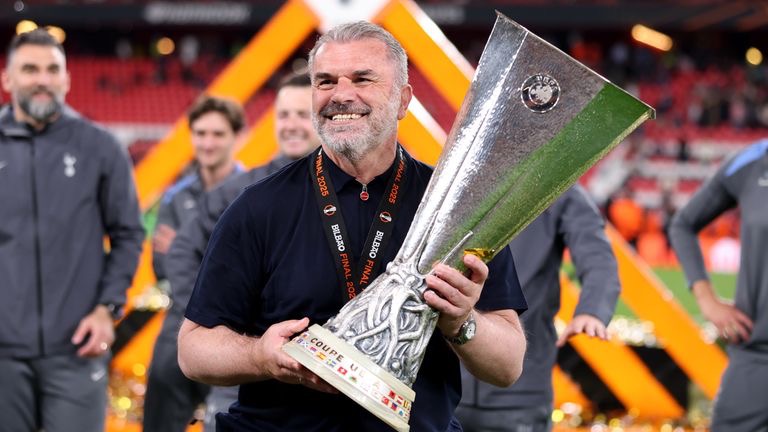
The Decisive Moment
The defining moment of a tense, low-quality final arrived in the 42nd minute — and, fittingly for a night marked more by discipline than flair, it came in scrappy fashion. Tottenham had struggled to carve out sustained attacks, but they didn’t need one. What they needed was a mistake, a lapse, a hesitation. And Manchester United provided it.
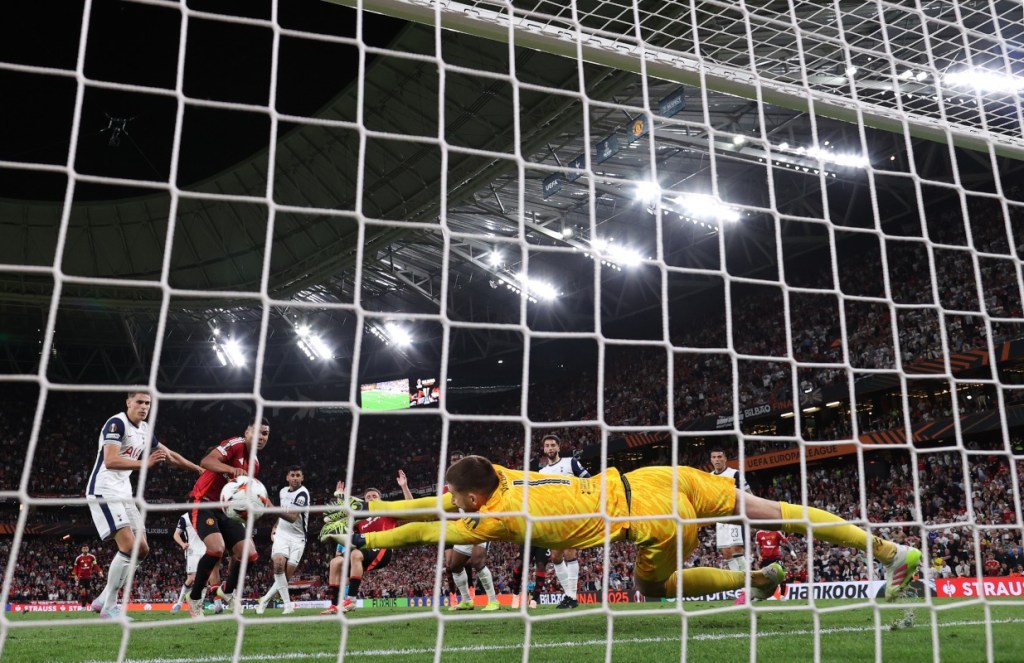
The goal began with Pape Matar Sarr, who had been one of Spurs’ most industrious performers in the first half. His curling cross from the right wasn’t especially dangerous on first glance — aimed into a congested penalty area where Harry Maguire, Luke Shaw, and Dominic Solanke all converged. But United failed to deal with it.Maguire misjudged the flight of the ball, allowing it to bounce awkwardly in the six-yard box. Shaw, caught flat-footed with Brennan Johnson ghosting in behind, couldn’t react quickly enough. Johnson got the slightest touch — enough to deflect it awkwardly back off Shaw’s midsection — and the ball trickled past Andre Onana, who had already committed and couldn’t recover his footing. It was a messy, indecisive goal. And it was all Spurs needed.
For Johnson, the goal capped off a season of personal milestones. Making his 50th appearance since joining from Nottingham Forest, he was a constant threat in the first half, targeting Shaw with sharp movements and direct running. Though his touch on the goal may not have been clean, the instinct to attack the space was what made it happen. “I don’t care who scored it,” Johnson told CBS after the match. “Kit man, defender, anyone — we just had to win, this club has been battered for not winning anything, tonight we got it done.” The goal will likely go down as Johnson’s — and even if UEFA had credited it as a Shaw own goal, few in the Tottenham camp would have cared. What mattered most was what it symbolised: a breakthrough, a lead to protect, and a moment where Tottenham showed they could capitalise on the fine margins that often decide cup finals.

Van de Ven and Vicario Step Up
As the second half wore on and the pressure intensified, Tottenham’s ability to withstand Manchester United’s growing momentum came down to a few crucial defensive interventions. With their backs to the wall and the final descending into a siege, two players stood out in preserving Spurs’ slender lead: Micky van de Ven and Guglielmo Vicario.
The pivotal moment arrived midway through the second half. United had grown into the game, pushing Tottenham deeper with each passing minute. A lofted free-kick into the box caused panic. Vicario came off his line but failed to claim cleanly, colliding with his own defender and spilling the ball. Rasmus Højlund was first to react, rising unmarked to head towards the open net. The equaliser seemed inevitable — until Van de Ven intervened. The Dutch centre-back, known for his recovery pace, produced a moment of stunning athleticism and awareness. Reacting in a split second, he flung his body backwards and managed to hook the ball clear just before it crossed the line. It was not just a clearance — it was a match-saving intervention. His positioning, timing, and courage under pressure epitomised the resilience Spurs needed to survive the onslaught.

“I saw the ball, I went for it, and I cleared it,” Van de Ven said after the match. “My back is still hurting from that landing, but it was worth it.” His pain was a price worth paying for a moment that could end up defining Tottenham’s modern history. But the job wasn’t done yet. In the seventh minute of stoppage time, with United committing every available body forward — including Harry Maguire operating as an emergency striker — Luke Shaw rose to meet a cross at the back post. His header looked destined for the far corner.
This time, it was Vicario’s turn. After an evening filled with uncertainty — misjudged aerials, nervy distribution, and moments that made the Spurs faithful wince — the Italian keeper delivered. He sprang low to his left and got a strong palm to the ball, pushing it around the post with enough force to ensure no rebound followed. It was his only truly convincing moment of the match — but in a final of few chances, it was decisive. Between Van de Ven’s acrobatic clearance and Vicario’s late reflexes, Spurs had their match-saving heroes. Neither moment will dominate the headlines like Brennan Johnson’s goal, but both were equally vital in sealing the result.
Vindication for Ange
When Ange Postecoglou stood in front of the media back in September and said, with quiet confidence, “I always win something in my second year,” it was met with raised eyebrows and rolled eyes. Tottenham had just suffered a disappointing defeat to Arsenal, were struggling with inconsistency, and looked miles off competing for silverware. For a manager new to the Premier League and at a club long mocked for failing to “get it done,” the statement felt more like wishful thinking than a credible prediction.
Fast forward eight months, and the Australian has delivered. Tottenham Hotspur are Europa League champions — their first trophy of any kind in 17 years and their first European title since the UEFA Cup in 1984. Against all odds and in the face of scepticism from fans and pundits alike, Postecoglou turned a faltering season into a historic one. The victory over Manchester United not only ends the club’s long wait for silverware but also secures Champions League football for next season — a reward worth around £100 million in revenue and prestige.Postecoglou didn’t inherit a blank canvas. He took over a club where belief had been worn thin, where high-profile managers with superior CVs — José Mourinho, Antonio Conte — had come and gone without ending the drought. When results dipped and injuries piled up, the pressure on Postecoglou mounted. He faced criticism for being too wedded to his principles, for defensive frailties, for poor game management. But on the biggest night of his tenure, he adapted. He delivered.
The image of Postecoglou on the touchline after the final whistle — visibly emotional, sharing hugs with staff and his family in the stands — felt like the full-circle moment of a season that often threatened to unravel. For a coach so often framed as an idealist, he showed steel and humility. His decision to prioritise the Europa League, even at the cost of domestic results, now looks like a calculated gamble that paid off. “People thought I was arrogant when I said that,” Postecoglou said post-match. “But I believed it. It wasn’t for the cameras. We had to change the way people view this club. And we have.”
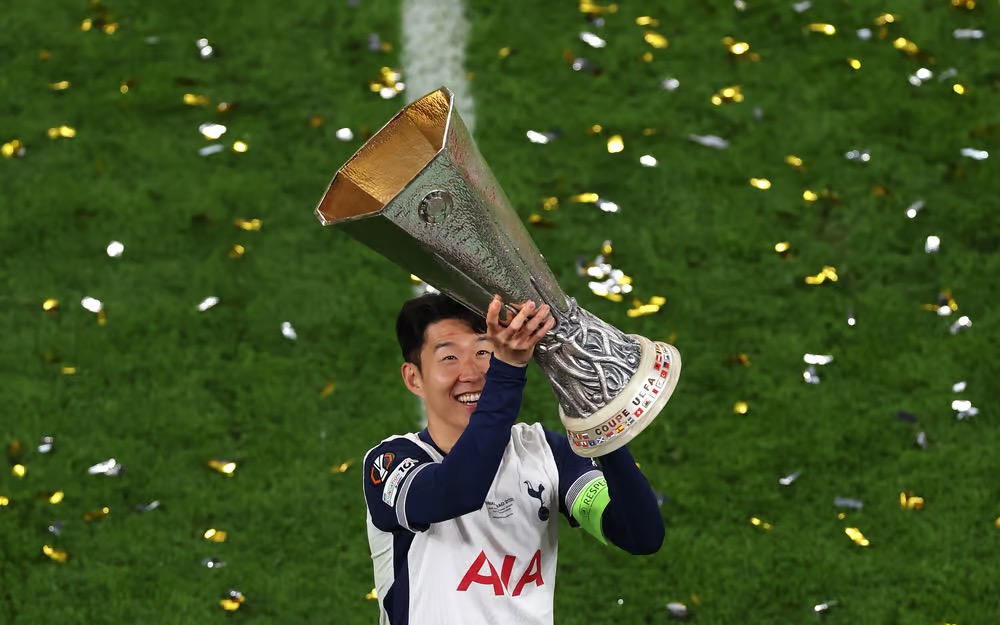
Heung-Min Son, the captain and longtime servant of the club, echoed that sentiment with a wry smile: “Let’s say I’m a legend — just for today. This is everything I dreamed of.” There’s a long way to go before Tottenham can be considered a perennial challenger at the very top of European football. But nights like this are foundations. They build belief. They change reputations.
United Flat Again
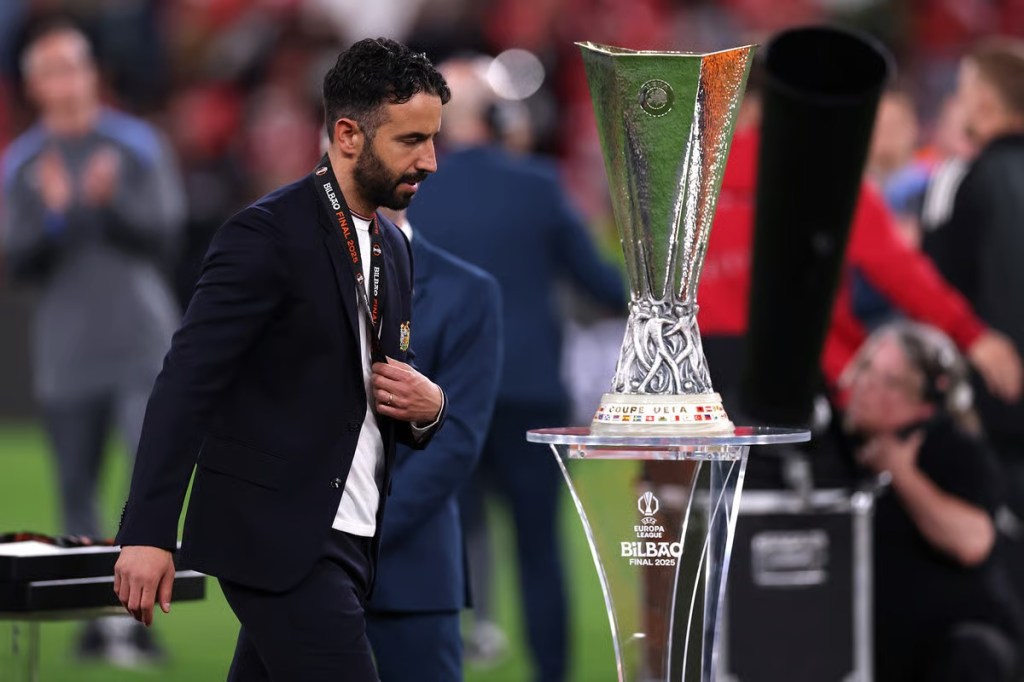
For Manchester United and head coach Ruben Amorim, this Europa League final represented not just a missed opportunity — but a painful confirmation of just how far the club has fallen. On the biggest stage of their season, with Champions League qualification and the chance for silverware on the line, United delivered another performance emblematic of their broader dysfunction: high on possession, low on penetration, and devoid of ideas when it truly mattered.
The numbers paint a misleading picture. United controlled 73% of the ball, registered 16 shots, and hit the target six times. But despite all the statistical dominance, they rarely tested Tottenham’s goalkeeper Guglielmo Vicario in any meaningful way until the dying moments. For all their territory, there was little incision. Their attacks were predictable and too often funneled into wide areas where Spurs were happy to absorb pressure and reset.
Bruno Fernandes, as ever, tried to shoulder the creative burden, but he was suffocated by a disciplined Spurs midfield three that denied him space and time on the ball. He completed just 11 passes in the first half and spent much of the match attempting hopeful crosses and long-range passes that were comfortably dealt with. When United’s best player is reduced to hitting speculative deliveries into a packed box, it’s a symptom of a system failing around him. Alejandro Garnacho injected some energy after coming off the bench, and Amad Diallo showed flashes of promise — twisting and turning with intent — but their impact was isolated. Tottenham’s structure held firm. The final ball was lacking. The runs weren’t timed. And for all the crosses aimed at Harry Maguire in a late centre-forward cameo, it felt more desperate than decisive.
The ramifications are severe. Financially, they miss out on UEFA prize money and the added blow of a reduced kit sponsorship deal. Strategically, their appeal to top-level talent diminishes. And culturally, the rot that has taken hold in recent seasons only deepens.After the match, Amorim cut a frustrated figure but maintained his belief in the project. “If they want me to go, I’ll go. No compensation,” he told reporters. “But I still believe I’m the right man.” This final — like so many United performances this season — was characterised by a lack of urgency, a lack of structure, and a growing disconnect between the manager’s ideas and the squad’s execution. That Garnacho and Amad — two of the youngest players in the squad — looked like United’s most dangerous threats will raise further questions about the reliance on youth without a coherent framework.
Ultimately, this was another major night where Manchester United failed to show up. Tottenham dictated the terms of the match — not with possession, but with control. United, for all their ball dominance, were playing a game Spurs wanted them to play. And once again, that sense of drift — tactical, institutional, and emotional — defined the performance.
What Next?
For Tottenham, this win has the potential to be more than just a one-off triumph — it could mark the start of a genuine cultural shift. For years, the club has been burdened by a reputation for flattering to deceive: good teams, talented players, promising seasons, but no silverware to show for it. That weight — a 17-year domestic drought and 41 years without a European trophy — has now been lifted.This victory gives tangible proof that the cycle of “nearly” can be broken. It tells a new story to fans who’ve only known heartbreak and to players who’ve never won before. A young, emerging core — the likes of Brennan Johnson, Pape Matar Sarr, Micky van de Ven, and Destiny Udogie — now knows what it takes to win under pressure. That experience could be transformational.
Whether Ange Postecoglou stays or not, his legacy is now secure. He took a squad short on belief and delivered them a major European trophy, Champions League qualification, and a financial windfall estimated at £100 million. His second-season promise wasn’t just a bold soundbite — it was a fulfilled prophecy. And it gives Spurs something they’ve lacked in recent years: a foundation to build from, and a reason to believe that more can follow. The question now becomes one of sustainability. Can Tottenham use this as a springboard? Can they build depth, retain key players, and navigate the extra demands of the Champions League while staying competitive in the Premier League? More immediately, can they persuade Postecoglou to stay — and if not, can they appoint someone who shares his long-term vision?
For Manchester United, by contrast, the future looks murkier. This was supposed to be a reset season under Ruben Amorim — a chance to modernise their tactical identity and get back to competing at the top. Instead, it has ended with the club finishing 16th in the Premier League, trophyless, and outside of European football altogether for the first time in a decade. The financial implications are significant. Without Champions League revenue, United will reportedly face a £10 million drop in their annual Adidas sponsorship deal. The lack of European football also means fewer matchday revenues, a weaker coefficient in UEFA rankings, and reduced attractiveness to elite transfer targets. In a summer where the squad badly needs investment and reshaping, those limitations could be costly. The pressure is mounting on Ineos and Sir Jim Ratcliffe, who now oversee football operations. The honeymoon period is over. There is no buffer from the failures of the past regime. The results — and more crucially, the lack of identity on the pitch — now reflect directly on their stewardship. The recruitment strategy, managerial backing, and sporting structure all require urgent clarity.
For Amorim, the coming days could determine his future. His post-match comments — “If they want me to go, I’ll go. No compensation” — suggest a man aware of the scrutiny but still confident in his vision. Whether that’s enough to convince the board and fans to stay the course is uncertain.
Ultimately, Bilbao offered a tale of two clubs heading in opposite directions. Tottenham seized a rare moment to reshape their narrative. United missed another to salvage theirs. What happens next could define their respective trajectories for years to come.
Final Whistle
Tottenham have long carried the stigma of being a nearly club — talented, ambitious, but fatally flawed when it truly mattered. On Wednesday night in Bilbao, they flipped the script. This wasn’t a display of dazzling football or free-flowing Angeball. It was measured, gritty, and at times backs-to-the-wall. But it was also composed, mature, and effective. Spurs showed a side of themselves that critics said didn’t exist — one built on defensive resolve, tactical flexibility, and collective sacrifice. They didn’t outplay Manchester United; they outlasted them. And in finals, that’s what counts.
Tottenham Hotspur, 2024–25 UEFA Europa League champions. It may not have been the prettiest path to glory, but for a club starved of silverware, it’s a landmark moment — proof that winning is possible, even when the odds and the aesthetics are against them. For a generation of fans who’ve known only near-misses and heartbreak, this wasn’t about playing the Spurs way. This was about rewriting what the Spurs way could be.




 Mission Podcast
Leave a comment