
Crystal Palace make history at Wembley
Eze delivers history as Glasner’s Palace lift first major trophy
By DK01__
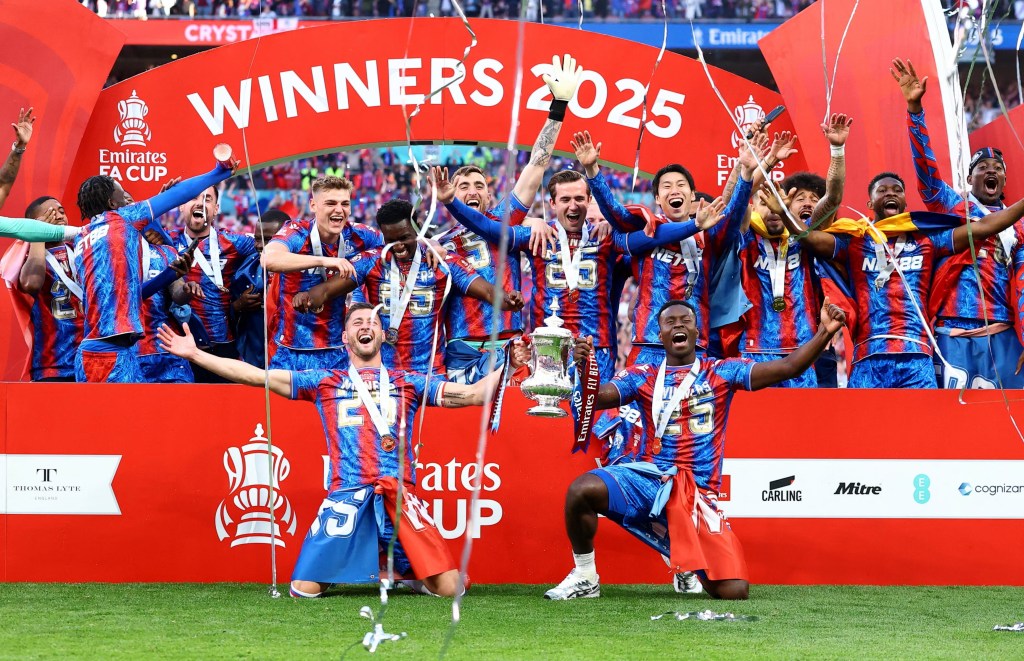
Crystal Palace produced one of the most tactically disciplined performances of the season to beat Manchester City 1-0 in the FA Cup final and secure the club’s first major trophy in its 119-year history. Eberechi Eze’s first-half strike, combined with a standout display from goalkeeper Dean Henderson, sealed a landmark result at Wembley.
Glasner’s impact
Oliver Glasner’s arrival midway through the 2023–24 season brought immediate structural clarity and tactical identity to Crystal Palace. The Austrian’s preference for a 3-4-3 shape — which transitions into a 5-4-1 when out of possession — has not only added defensive stability but also optimised the existing player profiles at the club. Within weeks of his appointment, Palace exhibited more compact spacing, clearer passing lanes in transition, and a collective understanding of off-ball responsibilities that had previously been inconsistent.
In the FA Cup final, that clarity was on full display. Palace operated with cohesion and positional discipline, maintaining a low-to-mid block that denied Manchester City access to central areas. Despite conceding over 70% of possession, they rarely allowed City to progress with fluidity through the middle third. The absence of a natural holding midfielder in Guardiola’s setup — coupled with Palace’s compactness between the lines — meant City were often funnelled wide, relying heavily on overlapping full-backs and individual dribbling to destabilise Palace’s shape.
Palace’s plan was deliberate: absorb pressure in a vertically narrow structure, force the ball into less dangerous zones, and then launch coordinated counter-attacks through Eberechi Eze, Daniel Muñoz, and Ismaïla Sarr. It was a continuation of Glasner’s tactical pattern — one developed during his previous spells at Wolfsburg and Eintracht Frankfurt — where defensive organisation is the foundation, and offensive threat comes not through possession volume but through pre-planned vertical movements when the ball is regained.
The success lies in the coordination. Palace don’t simply sit deep and hope to react. They defend in patterns, and once the ball is won, their attacking movements are sequenced: the wide centre-backs step into passing lanes, wing-backs advance quickly, and central creators like Eze move into space between opposition midfield and defence. Against a possession-heavy side like City, the discipline to maintain shape and the clarity to break purposefully is what ultimately separated the two sides.

Eze’s evolution
With Michael Olise now at Bayern Munich, Eberechi Eze has become the central creative figure at Palace — and the team has been rebuilt around him. Glasner’s adjustments have allowed Eze more positional freedom, typically operating as a free 10 or advanced left-sided midfielder depending on the build.
His goal — a first-time finish in the 16th minute from Daniel Muñoz’s cross — came from classic Glasner principles. Jean-Philippe Mateta’s hold-up play initiated the sequence, Muñoz overlapped from wing-back, and Eze timed his run ahead of Manuel Akanji to convert with composure.
In Glasner’s 3-4-3 system — which shifts into a compact 5-4-1 out of possession — Eze is deployed as the central figure behind the front line, granted freedom to drift between the lines and operate in both half-spaces. He’s not just Palace’s most dangerous ball-carrier, but also their primary tempo-setter in attacking transitions. His ability to receive under pressure, glide past markers, and accelerate play vertically allows Palace to break with purpose when winning the ball back in deep areas.
What distinguishes Eze’s current role is his dual function. In slower phases of possession, he links with the midfield double pivot and drops into pockets to progress play. But in moments of defensive turnover — which Glasner’s sides are designed to trigger — Eze becomes the immediate outlet. His composure in tight spaces and timing of release often determines the quality of Palace’s counter-attacks

Henderson’s moment
Dean Henderson was decisive. The goalkeeper saved a first-half penalty from Omar Marmoush — awarded after Bernardo Silva drew contact from Tyrick Mitchell — and made further saves from Erling Haaland and Jérémy Doku.
A potentially game-changing moment arrived when Henderson appeared to handle the ball outside his box to deny Haaland a clear run at goal. Despite protests, VAR did not recommend a red card. Minutes later, he saved the spot-kick. His presence was key in the closing stages as well, saving from debutant Claudio Echeverri and surviving a ten-minute period of stoppage time as City pressed for an equaliser.

City lack incision
This was the first season since 2016–17 that Manchester City have finished a campaign without silverware — a notable disruption to the sustained dominance that has defined Pep Guardiola’s tenure in England. The FA Cup final loss to Crystal Palace was emblematic of a broader theme that’s developed across the season: structural imbalance in the absence of key midfield profiles.
With Mateo Kovačić unavailable and Rodri suspended, Guardiola opted to start Kevin De Bruyne and Bernardo Silva as dual No.8s in front of a back four, with no recognised holding midfielder anchoring the midfield. The decision was likely made in pursuit of control in possession — an attempt to overload Palace’s compact mid-block with fluid rotation and technical superiority. However, the trade-off was a lack of defensive stability in central zones, particularly in transitional moments.
Without a natural ball-winner screening the back line, City were repeatedly exposed when possession was lost. Palace, who committed minimal numbers forward, had clear reference points when counter-attacking — often targeting the vacated space behind Silva and De Bruyne, who were positioned high and not equipped to defend transitions.
This structural vulnerability was evident in Eberechi Eze’s goal, where the turnover led to a fast-developing transition down the right. Jean-Philippe Mateta held up the ball, Daniel Muñoz surged into space, and De Bruyne was left trailing as Eze arrived unmarked between City’s disconnected midfield and back line. It was a moment that typified the gap between possession and protection in Guardiola’s setup.

Wharton and Muñoz key
Adam Wharton, signed from Blackburn Rovers on February 1st 2024, has quickly established himself as one of Crystal Palace’s most dependable and tactically mature midfielders. At just 21 years old, his integration into Oliver Glasner’s system has been seamless. Wharton’s composure under pressure, particularly in central areas, has added control and structure to Palace’s midfield. In the FA Cup final, he played a pivotal role in helping Palace manage long spells without possession — offering clean, secure touches in tight zones and acting as a pivot when transitioning from defence to attack.
His ability to receive on the half-turn, break passing lines, and delay opposition counter-pressing allowed Palace to escape pressure and launch vertical attacks with greater clarity. In a game where City frequently tried to flood central areas, Wharton’s positioning and anticipation were key to maintaining shape and resisting overloads.
On the right flank, Daniel Munoz was equally influential — offering constant verticality and energy. The Colombian international, signed in the same January window, provided the assist for Eberechi Eze’s goal with a well-timed run and driven cross. His overlapping runs consistently disrupted City’s left-side structure, and his willingness to commit forward in transition gave Palace an outlet that stretched the pitch.
Later in the match, Munoz thought he had scored a second, only for VAR to rule it out due to an offside touch by Ismaila Sarr. Regardless, his contribution was emblematic of Glasner’s tactical setup: full-backs or wing-backs not just defending in a low block but actively shaping transitions and attacking patterns. Muñoz’s dual role — defensively solid, yet offensively aggressive — underlined the balance that has come to define this version of Palace under Glasner.

Smart recruitment
The 2025 FA Cup final may be remembered as a historic moment for Palace, but more importantly, it reinforces a broader trend in the sport. With the right processes, mid-tier Premier League clubs can outmanoeuvre financial giants over 90 minutes. Smart recruitment, tactical adaptability, and a willingness to build around core player strengths continue to matter — even in a league defined by financial disparity.
City, meanwhile, end the season without winning a trophy. It’s a result that will likely lead to some reflection — both on the risks of overcomplicating tactics in big games and the lack of depth in midfield after injuries and player exits.





 Mission Podcast
Leave a comment